> For the complete documentation index, see [llms.txt](https://docs.ilert.com/llms.txt). Markdown versions of documentation pages are available by appending `.md` to page URLs; this page is available as [Markdown](https://docs.ilert.com/integrations/inbound-integrations/itconductor.md).
# IT-Conductor Integration
Integrate IT-Conductor with ilert to feed IT operations alerts into on-call workflows, enabling quick escalation and proactive issue resolution.
[IT-Conductor](https://www.itconductor.com/) is a patented, cloud-based service platform designed to monitor, manage, and orchestrate enterprise IT through intelligent automation. Connecting IT-Conductor with ilert ensures IT operations alerts – ranging from system anomalies to service outages – are instantly visible to on-call engineers. With structured alert routing and automated escalations, teams can resolve technical issues more efficiently and maintain reliable operations.
## In ilert: Create an IT-Conductor alert source
1. Go to **Alerting** → **Alert sources** and click **Create new alert source**.
2. Search for **IT-Conductor**, click its tile, and click **Next**.
3. Give your alert source a name, optionally assign teams, and click **Next**.
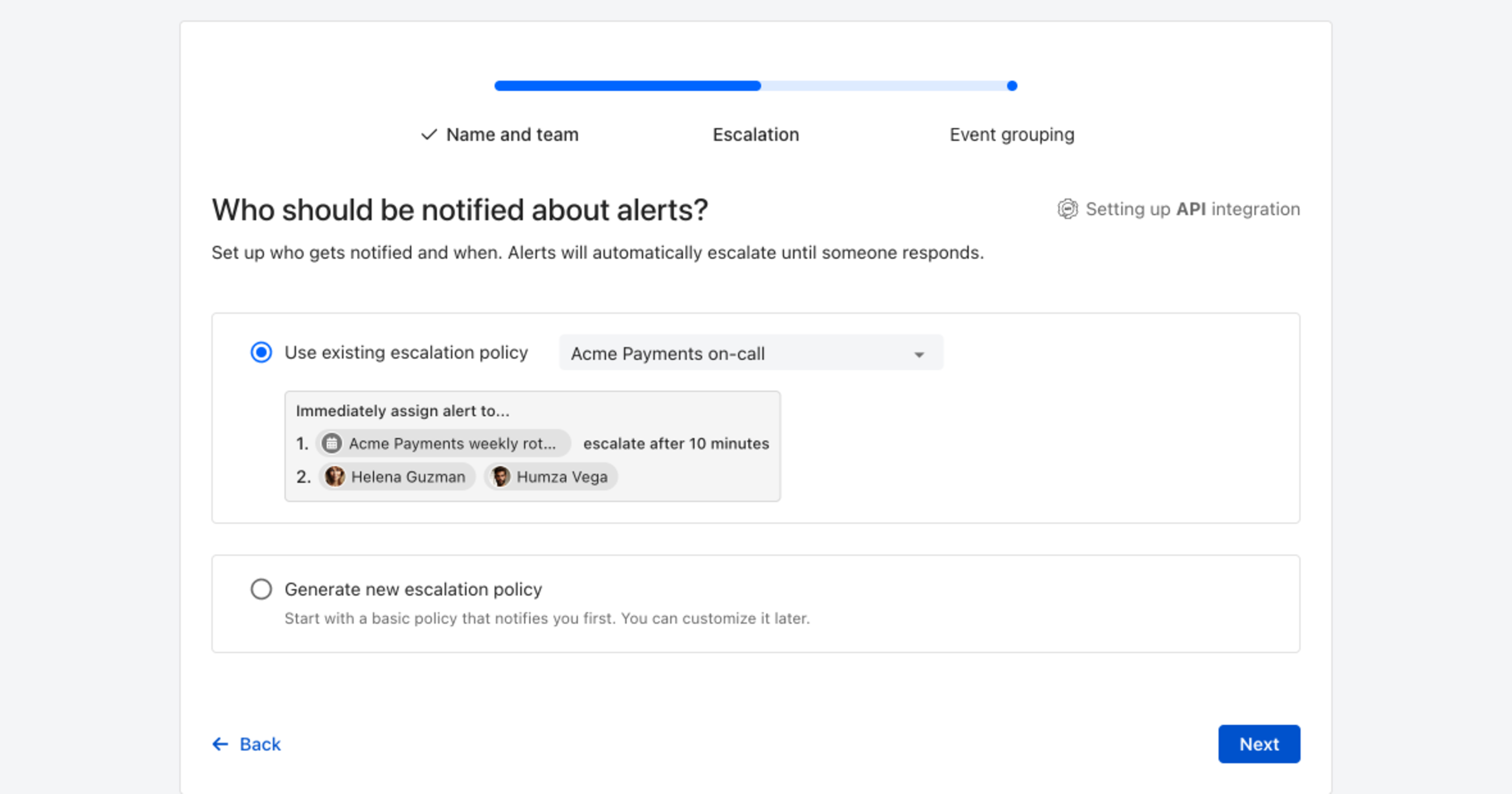
4. Choose who gets notified: select **Use existing escalation policy** and pick a policy, or **Generate new escalation policy** to start with a basic one that notifies you first. Click **Next**.
Pick an existing escalation policy, or generate a basic one without leaving the wizard.
5. Select **Default grouping** and click **Continue setup**. It groups events by the alert key the integration sets; the other [grouping options](/alerting/configure-alerting/alert-sources.md#event-grouping) are easier to judge once events are arriving.
6. The next page shows more settings, such as notification priority and alert templates. Click **Finish setup** for now; you can change them later.
7. On the final page, ilert shows the integration key and URL for this alert source. You will need them later in this guide.
## In IT-Conductor: Create an Integration Provider
1. On the top bar, navigate to **Management** -> **Notification** -> **Integration Providers**.
2. Click on the ilert symbole.
3. Select the desired **Role** and **Gateway**.
4. Add the Integration key of the ilert alert source into the Integration Key field.
---
# Agent Instructions
This documentation is published with GitBook. GitBook is the documentation platform designed so that both humans and AI agents can read, navigate, and reason over technical content effectively. Learn more at gitbook.com.
## Querying This Documentation
If you need additional information that is not directly available in this page, you can query the documentation dynamically by asking a question.
Perform an HTTP GET request on the following URL with the `ask` and `goal` query parameters:
```
GET https://docs.ilert.com/integrations/inbound-integrations/itconductor.md?ask=&goal=
```
`ask` is the immediate question: it should be specific, self-contained, and written in natural language.
`goal` is what the user is ultimately trying to achieve, the reason they need the answer. Sharing it helps GitBook give you a better, more relevant answer. A goal is most helpful when it describes the outcome the user wants rather than restating the question. For example, with `ask=how do I create an API token`, a goal like `build a script that syncs our docs to a CMS` lets GitBook tailor the answer to that use case.
The response will contain a direct answer to the question and relevant excerpts and sources from the documentation.
Use this mechanism when the answer is not explicitly present in the current page, you need clarification or additional context, or you want to retrieve related documentation sections.