> For the complete documentation index, see [llms.txt](https://docs.ilert.com/llms.txt). Markdown versions of documentation pages are available by appending `.md` to page URLs; this page is available as [Markdown](https://docs.ilert.com/integrations/inbound-integrations/sensu.md).
# Sensu Integration
The ilert Sensu Integration helps you to publish alerts into your channels or resolve alerts.
[Sensu](https://sensu.io/) is a tool that functions as an observability pipeline which delivers monitoring as code on any cloud.
## In ilert: Create a Sensu alert source
1. Go to **Alerting** → **Alert sources** and click **Create new alert source**.
2. Search for **Sensu**, click its tile, and click **Next**.
3. Give your alert source a name, optionally assign teams, and click **Next**.
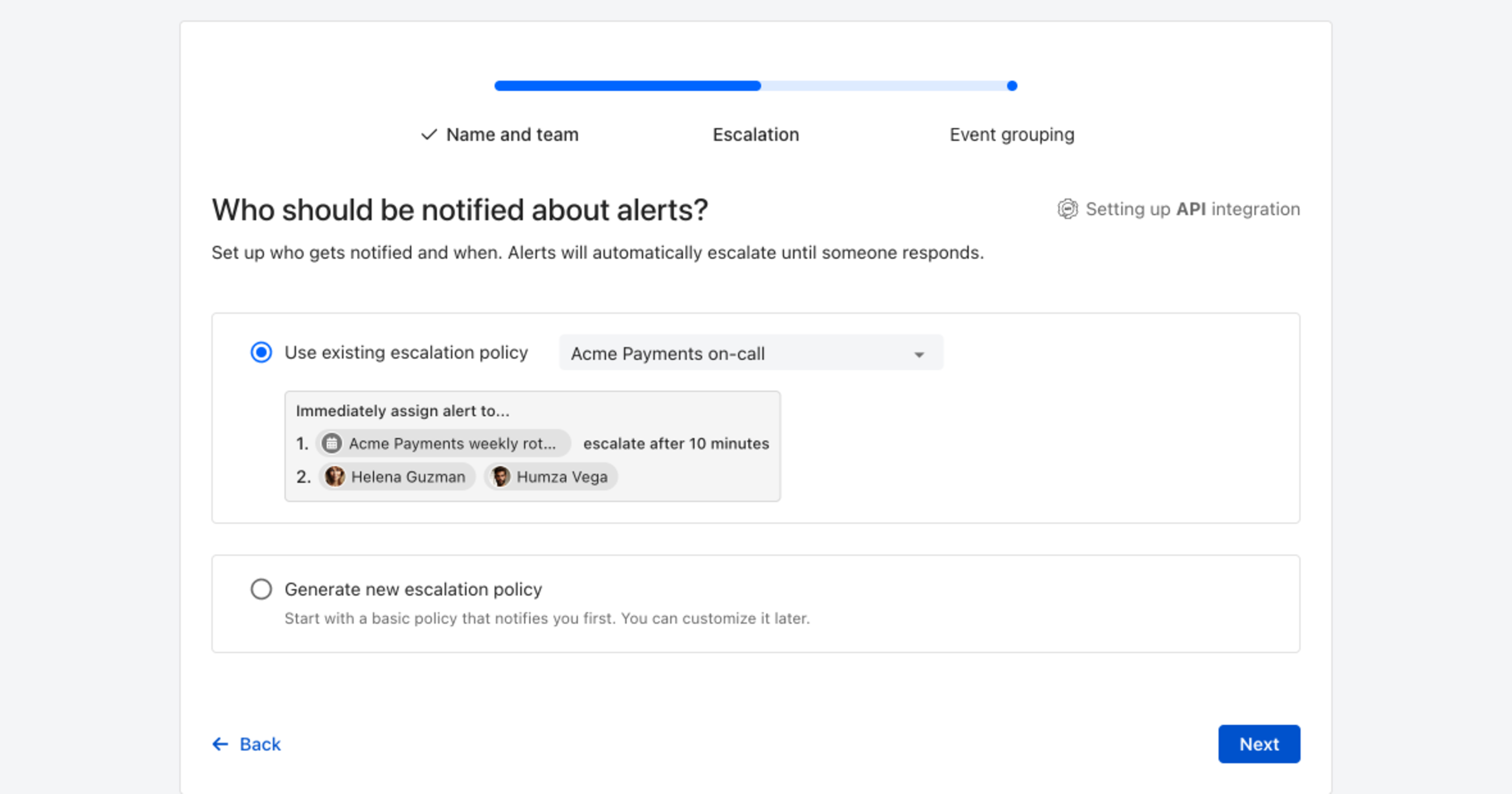
4. Choose who gets notified: select **Use existing escalation policy** and pick a policy, or **Generate new escalation policy** to start with a basic one that notifies you first. Click **Next**.
Pick an existing escalation policy, or generate a basic one without leaving the wizard.
5. Select **Default grouping** and click **Continue setup**. It groups events by the alert key the integration sets; the other [grouping options](/alerting/configure-alerting/alert-sources.md#event-grouping) are easier to judge once events are arriving.
6. The next page shows more settings, such as notification priority and alert templates. Click **Finish setup** for now; you can change them later.
7. On the final page, ilert shows the integration key and URL for this alert source. You will need them later in this guide.
## In Sensu
1. Add Sensu ilert Handler
```
sensuctl asset add iLert/sensu-ilert
```
2. Make sure that the asset was added to your Sensu backend. Run:
```
sensuctl asset info iLert/sensu-ilert
```
3. In the following command, replace **\** with your ilert API key.
Then run the updated command:
```
sensuctl handler create ilert \
--type pipe \
--runtime-assets iLert/sensu-ilert \
--command "sensu-ilert -t "
```
4. Make sure that your handler was added by retrieving the complete handler definition in YAML or JSON format:
```
sensuctl handler info ilert --format yaml
```
5. Trigger an event. You can try it with the **file\_exists** check and an ilert handler workflow in place - remove a file to cause Sensu to send a non-OK event.
You can refer to the next section for more instructions.
## Triggering an event
### Add system subscription to entity
1. Find your entity name:
```
sensuctl entity list
```
2. The `ID` in the response is the name of your entity and replace `` with the name of your entity in the `sensuctl` command below. Then run the command to add the `system` subscription to your entity:
```
sensuctl entity update
```
3. For `Entity Class`, press enter.
4. For `Subscriptions`, type `system` and press enter.
5. Confirm both `sensu-backend` and `sensu-agent` are running. You can use `docker ps` if you are running both from docker.
### Add the `file_exists` check
1. Before you can add the check, you need to add the Nagios Foundation asset to your Sensu configuration:
```
sensuctl asset add ncr-devops-platform/nagiosfoundationCopy
```
2. To confirm that the asset was added to your Sensu backend, run:
```
sensuctl asset info ncr-devops-platform/nagiosfoundationCopy
```
3. The check command includes the path for the file that the check will look for on your system, `/tmp/my-file.txt`. For this guide, you'll add `/tmp/my-file.txt` as a temporary file:
```
touch /tmp/my-file.txt
```
4. You should see `=== ncr-devops-platform/nagiosfoundation` followed by a list of available builds for the asset. Now that you've added the Nagios Foundation dynamic runtime asset, you can add its `file_exists` check to your Sensu backend. Use sensuctl to add the check:
```
sensuctl check create file_exists \
--command "check_file_exists --pattern /tmp/my-file.txt" \
--subscriptions system \
--handlers ilert \
--interval 10 \
--runtime-assets ncr-devops-platform/nagiosfoundationCopy
```
5. To confirm that the check was added to your Sensu backend and view the check definition in YAML or JSON format,
```
sensuctl check info file_exists --format yaml
```
### Trigger a `file_exists` check
1. Remove the file `/tmp/my-file.txt`:
```
rm /tmp/my-file.txtCopy
```
2. This will make sure the file is **not** there for Sensu to find the next time the `file_exists` check runs. After about 10 seconds, Sensu will detect that `my-file.txt` is missing and reflect that in an event. To view the event with `sensuctl`, run:
```
sensuctl event listCopy
```
3. The response should show that the file removal resulted in a *CRITICAL (2)* event:
```
Entity Check Output Status Silenced Timestamp UUID
────────────── ───────────── ──────────────────────────────────────────────────────────────────────── ──────── ────────── ─────────────────────────────── ──────────────────────────────────────
host01 file_exists CheckFileExists CRITICAL - 0 files matched pattern /tmp/my-file.txt 2 false 2021-03-15 19:28:21 +0000 UTC 1b4266ae-7200-4728-a0n4-2f50f7a56613Copy
```
4. Open the Sensu web UI to see the events the `file_exists` check is generating. Visit , and log in as the admin user (created during initialization when you installed the Sensu backend). The failing check's events will be listed on the **Events** page.
5. The Alert should be created on the Sensu Alert Source on ilert's side as well
6. To complete your workflow, restore the file that you removed so Sensu sends a resolution to ilert:
```
touch /tmp/my-file.txt
```
---
# Agent Instructions
This documentation is published with GitBook. GitBook is the documentation platform designed so that both humans and AI agents can read, navigate, and reason over technical content effectively. Learn more at gitbook.com.
## Querying This Documentation
If you need additional information that is not directly available in this page, you can query the documentation by asking a question.
Perform an HTTP GET request on the following URL with the `ask` and `goal` query parameters:
```
GET https://docs.ilert.com/integrations/inbound-integrations/sensu.md?ask=&goal=
```
`ask` is the immediate question: it should be specific, self-contained, and written in natural language.
`goal` is what the user is ultimately trying to achieve, the reason they need the answer. Sharing it helps GitBook give you a better, more relevant answer. A goal is most helpful when it describes the outcome the user wants rather than restating the question. For example, with `ask=how do I create an API token`, a goal like `automate deployments from our CI pipeline` lets GitBook tailor the answer to that use case.
The response will contain a direct answer to the question and relevant excerpts and sources from the documentation.
Use this mechanism when the answer is not explicitly present in the current page, you need clarification or additional context, or you want to retrieve related documentation sections.