> For the complete documentation index, see [llms.txt](https://docs.ilert.com/llms.txt). Markdown versions of documentation pages are available by appending `.md` to page URLs; this page is available as [Markdown](https://docs.ilert.com/chatops/slack/post-alerts-to-a-slack-channel.md).

# Receive and respond to alerts in Slack

{% hint style="info" %}
**Connect your Slack workspace with ilert first**

Before you proceed, please make sure that a global admin has connected your Slack workspace with your ilert account (as described in our [integration for Slack guide](/chatops/slack.md))
{% endhint %}

Alerts reach Slack through an **alert action** — a rule on an alert source that publishes to a channel. Create one per channel you want to post to.

## Create a Slack alert action <a href="#in_slack" id="in_slack"></a>

{% stepper %}
{% step %}

## Start a new alert action

In the sidebar, go to **Alerting** → **Alert actions** and click **Create new alert action**.
{% endstep %}

{% step %}

## Choose Slack

Select **Slack**. Leave **Use webhook** unticked — the webhook variant posts plain messages without the action buttons.

<figure><img src="/files/kXLqXH9dfxNqmfPakoTP" alt="The Create alert action dialog, showing a grid of connector types with Slack selected and its Use webhook checkbox unticked."><figcaption><p>Pick Slack, and leave <strong>Use webhook</strong> unticked to get interactive alert messages.</p></figcaption></figure>
{% endstep %}

{% step %}

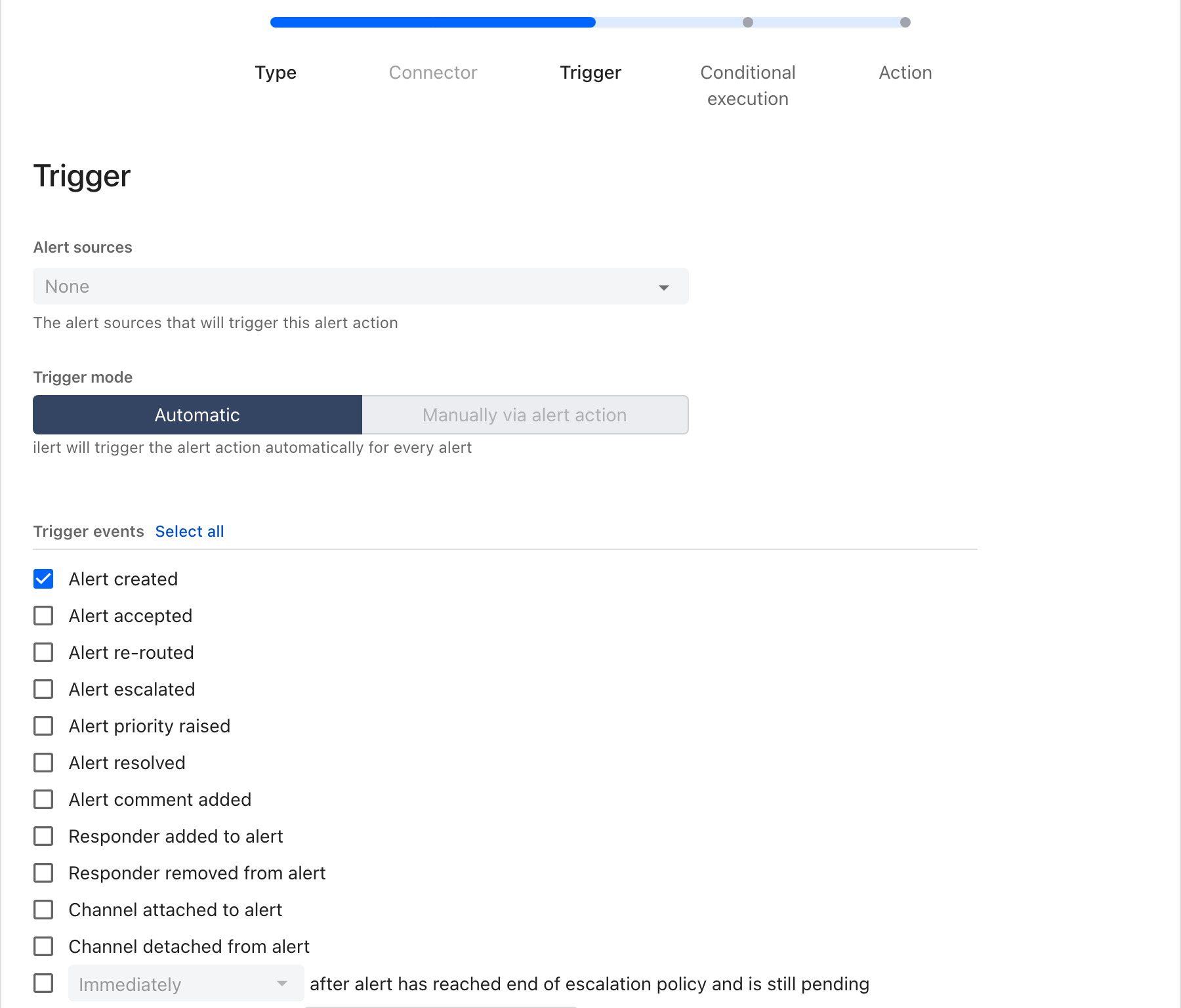
## Pick the alert source and the events to publish

Click **Next**, then choose the alert source and which events should reach Slack. *Alert created, accepted, resolved and comment added* is a good default.
{% endstep %}

{% step %}

## Skip the conditions

Click **Next** past the conditional execution page unless you want payload filters now.
{% endstep %}

{% step %}

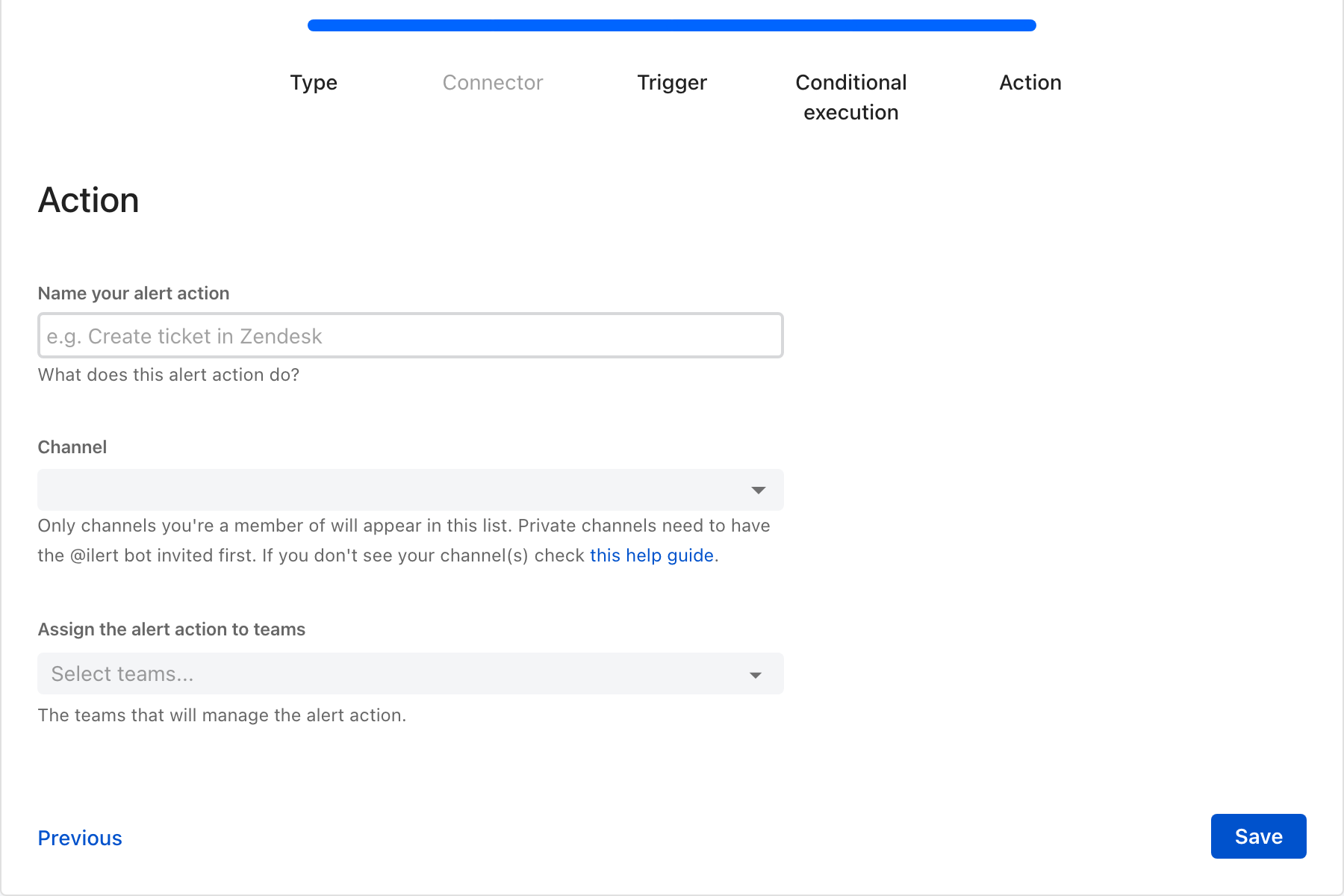
## Name it and choose the channel

Give the alert action a name and select the target channel.

<figure><img src="/files/tcbfI5VNneSEeOrpgLHk" alt="The Action step of the wizard: a Name your alert action field reading Publish to Slack Channel, a Channel typeahead showing a matching developers channel, and an optional Assign the alert action to teams field."><figcaption><p>The channel field is a typeahead. If it comes up empty, see the FAQ below.</p></figcaption></figure>
{% endstep %}

{% step %}

## Save

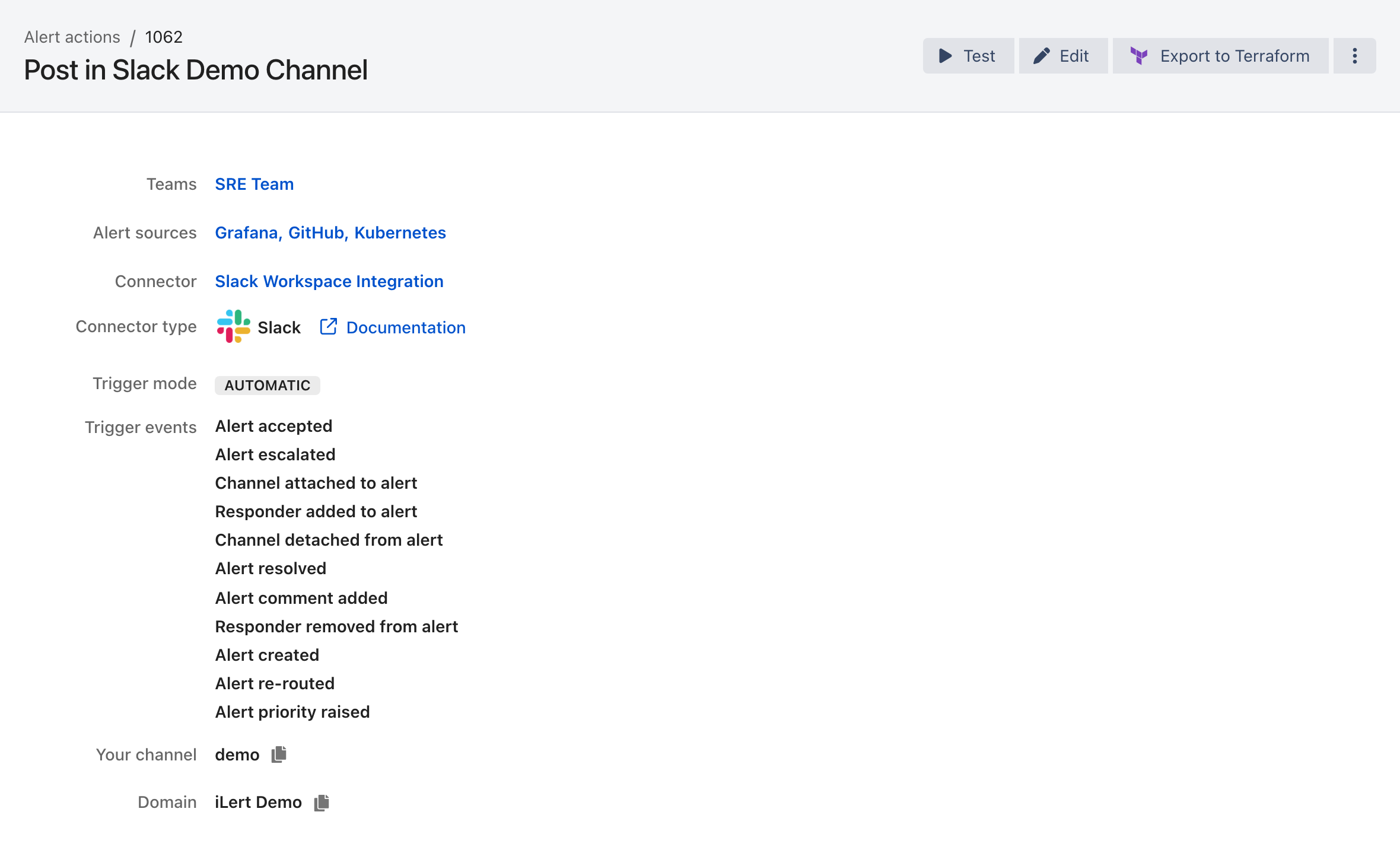
Click **Save**, then **Save** again on the edit view to reach the alert action's detail page.

<figure><img src="/files/5R973MABzt69wm3G6sXt" alt="An alert action detail page titled Publish to Slack Channel, listing its alert source, connector, trigger mode Automatic, trigger events, and target channel, with Test and Edit buttons at the top right."><figcaption><p>The detail page summarizes what will be published, and where.</p></figcaption></figure>
{% endstep %}

{% step %}

## Test it

Click **Test** in the top right. A test alert appears in the channel.

<figure><img src="/files/DDTIJQ5winQYyun6s27c" alt="A Slack channel showing a message from the ilert app headed PENDING Test Alert, with escalation policy, priority, and a link to the alert." width="375"><figcaption><p>The test message confirms the connection.</p></figcaption></figure>
{% endstep %}
{% endstepper %}

{% hint style="info" %}
The test message has no action buttons. Real alerts arrive with them — accept, resolve, and more.
{% endhint %}

## FAQ

### Are updates to an alert published in Slack?

Yes. These events can be published:

| Event                   | Happens when                                              |
| ----------------------- | --------------------------------------------------------- |
| **Alert escalated**     | The alert moves to the next escalation level              |
| **Alert re-routed**     | Someone assigns the alert to a different policy or person |
| **Alert accepted**      | A responder takes ownership                               |
| **Alert resolved**      | The alert is closed                                       |
| **Alert comment added** | Someone comments on the alert                             |
| **Merges**              | The alert is merged into another                          |

### Can I choose which updates to an alert are published in Slack?

Yes. Edit the alert action and change its trigger events.

### Why am I not seeing my Slack channels in the ilert UI?

Three things have to be true before a channel appears in the dropdown.

**First**, your ilert account email must match your Slack account email. ilert enforces Slack's own channel permissions, and it uses the email to work out who you are in Slack. If they differ, the dropdown stays empty.

{% hint style="warning" %}
Where the two emails cannot be kept in sync, ilert detects this and lets administrators list every channel the Slack bot can access. Non-admin users still see an empty list and have to ask an administrator. Keeping the emails in sync is the better option — then Slack's channel permissions apply to every role, administrators included.
{% endhint %}

**Second**, you must be a member of the channel at the time you create the alert action. You can leave afterwards. In practice this means the channel has to appear under **Channels** in your Slack sidebar.

<figure><img src="/files/mZzpEJIPKRZI5KIFEfOt" alt="The Channels section of a Slack sidebar listing two joined channels." width="177"><figcaption><p>The channel has to be one you have joined.</p></figcaption></figure>

**Third**, public channels appear immediately, but private ones do not. Invite the ilert bot to a private channel — after joining it yourself — by mentioning `@ilert` and sending the message.

<figure><img src="/files/Ay1jRokXw2ND46I6n1yR" alt="A private Slack channel with @ilert typed into the message composer, ready to send." width="375"><figcaption><p>Mention the bot and send the message.</p></figcaption></figure>

Slack then offers to add the bot.

<figure><img src="/files/XGPY0HKLiE8XwdzQGiW8" alt="A Slackbot message visible only to the sender, reading that @ilert was mentioned but is not in this private channel, with Add Them and Do Nothing buttons." width="375"><figcaption><p>Click <strong>Add Them</strong>.</p></figcaption></figure>

<figure><img src="/files/5koCuEjnLorPNie5AAuT" alt="A Slack channel message confirming that the ilert app was added to the channel." width="346"><figcaption><p>Confirmation that the bot has joined.</p></figcaption></figure>

Back in the alert action, search again or reload the page. The channel now appears.


---

# Agent Instructions
This documentation is published with GitBook. GitBook is the documentation platform designed so that both humans and AI agents can read, navigate, and reason over technical content effectively. Learn more at gitbook.com.

## Querying This Documentation
If you need additional information that is not directly available in this page, you can query the documentation dynamically by asking a question.

Perform an HTTP GET request on the current page URL with the `ask` query parameter, and the optional `goal` query parameter:

```
GET https://docs.ilert.com/chatops/slack/post-alerts-to-a-slack-channel.md?ask=<question>&goal=<endgoal>
```

`ask` is the immediate question: it should be specific, self-contained, and written in natural language.
`goal` is optional and describes the broader end goal you are ultimately trying to accomplish on behalf of the user. GitBook uses it to tailor the answer towards what is most useful for that goal.

The response will contain a direct answer to the question and relevant excerpts and sources from the documentation.

Use this mechanism when the answer is not explicitly present in the current page, you need clarification or additional context, or you want to retrieve related documentation sections.