> For the complete documentation index, see [llms.txt](https://docs.ilert.com/llms.txt). Markdown versions of documentation pages are available by appending `.md` to page URLs; this page is available as [Markdown](https://docs.ilert.com/alerting/configure-alerting/notification-settings/mute-notifications.md).
# Mute notifications
Silence every ilert notification channel for a set period — a night off, a flight, a holiday.
Muting stops ilert reaching you on any channel until a time you pick. It is the blunt instrument, deliberately: there is nothing to configure per-channel and nothing to undo afterwards, because it expires on its own.
## Turn it on
1. Click your avatar in the top right.
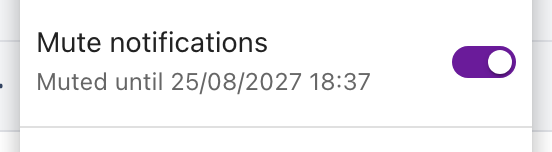
2. Toggle **Mute notifications**.
3. Under **Mute for**, pick a preset duration, or **Custom …** and set an end date and time. The **+1 hour**, **+3 hours** and **+1 day** shortcuts fill it in.
4. Click **Mute notifications**.
While muting is active the row shows when it expires. Toggle it off to end early.
The dialog names alerts and on-call reminders. Muting silences more than those two; see [what muting does and does not do](#what-muting-does-and-does-not-do).
Read the third line before relying on this.
{% embed url="" %}
A two-minute walkthrough
{% endembed %}
## What muting does and does not do
Muting covers every category of [notification rule](/alerting/configure-alerting/notification-settings.md#notification-rules), on every channel — push, SMS, phone call, email, WhatsApp, Telegram.
| Notification | While you are muted |
| ---------------------------------------------------------------------------------------------------------------- | ----------------------------------------------------------------------- |
| Alerts, high and low priority | Silenced |
| [Incident pages](/alerting/configure-alerting/notification-settings.md#incident-pages) | Silenced. The incident still lists you as **Notified** |
| [Alert updates](/alerting/configure-alerting/notification-settings.md#alert-updates) | Silenced |
| [Status update notifications](/alerting/configure-alerting/notification-settings.md#status-update-notifications) | Silenced, for every incident, service and status page you subscribe to |
| On-call reminders for your upcoming shifts | Silenced |
| Live calls to a [call routing](/call-routing/getting-started-with-call-routing.md) number | **Not silenced.** Someone calling your support line still rings through |
{% hint style="warning" %}
**Muting does not take you off call.**
Alerts are still assigned to you, and escalation still runs its clock against you — you simply are not told. If you are genuinely away, add a [schedule override](/on-call-management-and-escalations/on-call-schedules.md) so someone else is on call, and mute on top of that if you want the quiet as well.
{% endhint %}
## Your colleagues can see it
While you are muted, your avatar carries a small crossed-out bell everywhere it appears in ilert — responder lists, schedules, alert timelines. Hovering it shows **Muted until** and the time. Someone deciding whom to pull into an incident can see at a glance that you will not hear them.
An alert that tried to reach you says so on its timeline: "Could not notify *your name*, because notifications were muted."
## FAQ
### Can I end a mute early?
Yes. Open the user menu and toggle **Mute notifications** off.
### Can an admin mute someone else?
No. Muting is yours alone. An admin can change another user's notification rules, but not mute them.
### Does muting stop alerts from being created?
No. Alerts are created, assigned and escalated exactly as usual. Muting only suppresses the notifications that would have reached you. To stop alerts being created, use a [maintenance window](/alerting/configure-alerting/maintenance-windows.md).
### Which plans include this?
All of them, including Free.
---
# Agent Instructions
This documentation is published with GitBook. GitBook is the documentation platform designed so that both humans and AI agents can read, navigate, and reason over technical content effectively. Learn more at gitbook.com.
## Querying This Documentation
If you need additional information that is not directly available in this page, you can query the documentation by asking a question.
Perform an HTTP GET request on the following URL with the `ask` and `goal` query parameters:
```
GET https://docs.ilert.com/alerting/configure-alerting/notification-settings/mute-notifications.md?ask=&goal=
```
`ask` is the immediate question: it should be specific, self-contained, and written in natural language.
`goal` is what the user is ultimately trying to achieve, the reason they need the answer. Sharing it helps GitBook give you a better, more relevant answer. A goal is most helpful when it describes the outcome the user wants rather than restating the question. For example, with `ask=how do I create an API token`, a goal like `automate deployments from our CI pipeline` lets GitBook tailor the answer to that use case.
The response will contain a direct answer to the question and relevant excerpts and sources from the documentation.
Use this mechanism when the answer is not explicitly present in the current page, you need clarification or additional context, or you want to retrieve related documentation sections.